
Dark exciton dynamics revealed in single-layer tungsten disulfide
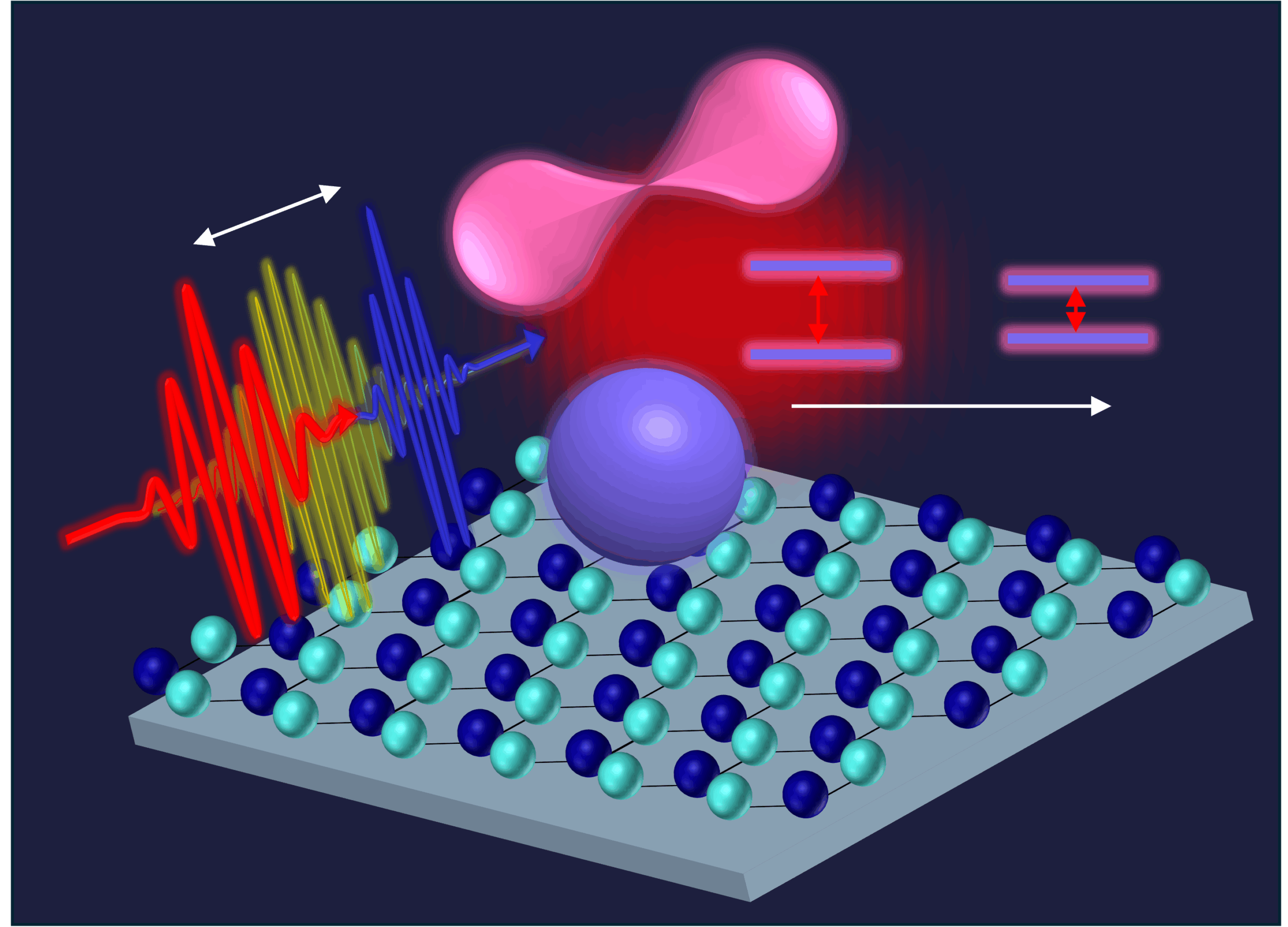
Our new paper is out! We demonstrate an approach to track in real time the dynamics of a normally invisible excited state in an atomically thin material.
In single-layer WS2, electrons and holes bind into excitons. Some exciton states are “bright” and emit light, while others are “dark” and usually cannot be seen, even though they strongly influence how the material absorbs and stores energy. Previous experiments could only infer dark states indirectly and mostly under steady-state conditions.
In our work we use a sequence of three ultrafast laser pulses to make a dark exciton reveal itself through an optical effect called Autler-Townes splitting: a strong mid-infrared pulse couples a bright and a dark state and splits the bright exciton level into two peaks. By tracking how this splitting changes after a visible pump pulse, we reconstruct in real time how the energy of the dark 2p exciton shifts and broadens as photo-generated charges and other excitons screen it.
This method provides the first direct view of the ultrafast dynamics of a dark exciton in a two-dimensional semiconductor and offers a general strategy to probe otherwise inaccessible states in a wide range of nanostructured and photonic materials.
A. Montanaro*, F. Valiera* et al., Phys. Rev. Lett. 136, 016902 (2026)